Showing posts with label Back-Up. Show all posts

Monday, April 21, 2014

Enslaved by brains: a ragecomic representation

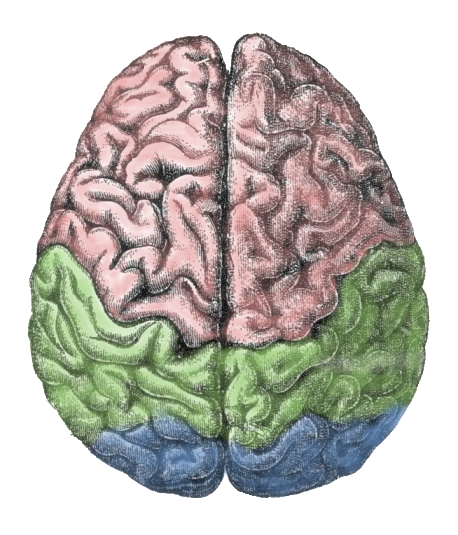
http://upload.wikimedia.org/wikipedia/commons/8/85/Cerebral_lobes.png
I previously mentioned that I started work in a research lab after graduation. People have asked me, both on the blog and email, what I actually do at work... truthfully, I wasn't completely sure of what I was doing until recently. Simply put (without being specific and compromising anonymity due to some recently published work)- I look at brains. I look at a lot of brains. Different kinds of brains. My work consists of:

1. Look at brains.
2. Make cool & pretty pictures.
3. Draw dots and lines.
4. Look at more brains.
5. Repeat 1-4

To illustrate, here is what a work day looks like for me (for those who's familiar with this line of work, of course I don't work with all imaging modalities- just a few from below):

Figure 1. Enslaved by brains.

I look at brains at work, commute home, then look at more brains... up to a maximum of 13 hours a day. Craploads of brains. Clearly, I like brains. This has been going on for ~1.5 years now.

Something important to note is that I initially started this job mostly as a back-up plan... but as time passed, I started to really enjoy working in research. So much that I applied for PhD programs, not as a back-up (especially considering I'm terrible at interviews by consensus, and truly not hopeful for anything in May) but as an alternative path for me to choose. Throughout undergrad, I barely considered research at all since it didn't seem interesting- so I ruled it out altogether.... but I happened to find the perfect supervisor & lab & field, all at the same time and things fell in place. At this time, I can say that I'm a little more passionate about research than medicine, and will be continuing research regardless of what happens in the near future. Funny how things change.

Lessons learned: 
-Science is hard, but cool. Brains even more so.
-Don't rule out possible opportunities and paths in life. Med school really isn't everything.
-From my biased, entirely personal point of view (entirely due to the fact that I've been having a hard time with interviews): if you're bad at med school interviews, you might enjoy research more than medicine. More on that later.

Matt

Sunday, December 30, 2012

Big List of "Back-Up" Plans for Premeds- Part 4: Nursing

This is Part 4 of my Big List of "Back-Up" Plans for Premeds series, intended to give a brief introduction to some alternate careers in health care that premeds might consider pursuing.

I would like to introduce nursing as a career, and accelerated nursing programs that you can enter after having completed some university work. 

What does a nurse actually do?
  • Nurses perform a wide range of duties, from:
    • Technical- i.e. monitoring the patient's vital signs, I.V.s & medical devices, collecting samples.
    • Administrative/Educative- maintaining records, triage, educating public & families.
    • Clinical- assess the patient, evaluate care diagnostic testing, dispensing medication, small procedures.
    • Counseling support for patients and families as well as personal hygiene.
    • ...and many more. There are thousands of things that nurses do and I can't compress that into a neat list.
  • Nurses work in a variety of settings- direct care, research, education, public health, etc. Find out more at the Canadian Nurses Association.
I think one of the greatest benefits for nursing is that there are a lot of things you can do with a nursing degree after graduation- there are a lot of choices that you can take advantage of. Furthermore, the role and scope of nursing is always expanding in Canada.

Possibility of further training
  • With further training, nurses are able to extend the scope of their practice. There are advanced training opportunities available for Registered Nurses, such as:
    • Anesthesia assistant, advanced life support (cardiac, pediatric, etc) certificates
    • Procedure-based training such as ultrasound, sonography
    • Research training- clinical research associate
    • Clinical nurse specialist
    • Administration
  • Nurse practitioner- NPs act as primary health care providers, functioning autonomously at a similar level of scope and authority as family physicians/physician assistants/etc. You can become an NP by going through advanced programs (usually Master of Nursing, Nurse Practitioner programs) after becoming a RN.

With that said, since this is a "Back-Up" series I will only write regarding Accelerated Nursing programs which have shorter time frames (~2 years) than regular nursing programs (~4 years).

Important points regarding Accelerated Nursing Programs in Canada:
  • Generally 2-year long programs entering at Level III (third year) of regular nursing programs, includes both theory and clinical components.
  • Often require X number of university credits (usually 10 full course credits= 2 full years), and ~B averages (~75%, 3.0).
  • Prerequisite courses generally include physiology, anatomy, psychology, statistics. Check school websites for details.
  • There are plenty of accelerated nursing programs, ranging from 1.8 to 3.5 years in length.
Potential salary & Job security/market

As you may already know, nurses usually have no problem finding a job. In 2010, 93.4% of RNs were employed in nursing, 1.8% outside of nursing, while only 2.7% were unemployed. For Nurse Practitioners, 97.3% were employed in nursing, 0.6% outside of nursing, and only 0.9% unemployed. Considering there were 287,344 RNs and 2554 NPs in 2010, I would say the job security for nurses look great.

Salaries are based on:
  • Seniority/experience
    • For example, hospital nurses in Ontario are paid according to a "grid" where salary increases with each year of experience for RNs.
    • Starting salary is $30.17/hr ($58,831.50 annual), while after 5 years it's $36.12/hr ($70,434.00).
  • Amount of additional training
    • RNs with advanced training are paid slightly more, along with increased flexibility and scope of their practice in terms of locations, hours, etc. For example, salary for NPs range from $80,000 to +$100,000, which is significantly higher than average RN salaries.
  • Location
    • Similar to other healthcare professions, pay differs from province to province.
Nurses have a huge variety of options in employment and practice along with great job security- which makes nursing all the more attractive as an alternative profession in healthcare. Consider nursing before thinking about leaving Canada for international medical schools that are associated with increasing restrictions & difficulties (along with a huge price tag) of coming back to Canada.

Matt

Monday, October 29, 2012

Big List of "Back-Up" Plans for Premeds- Part 3: PT/OT


This is Part 3 of my Big List of "Back-Up" Plans for Premeds series, intended to give a brief introduction to some alternate careers in health care that premeds might consider pursuing.

I would like to introduce physiotherapists (PT) and occupational therapists (OT)- both professions play critical roles in healthcare, helping patients improve in ways different from medicine. They work in a variety of healthcare settings- hospitals, private practice, home care, industry, government.

PTs are responsible for "evaluating, restoring and/or enhancing physical function and independence" through their "knowledge of the muscles, tendons, ligaments and bones of your body along with a thorough understanding of how they all work together." (Manitoba Physiotherapy Association)
OTs  "provide the skills for the job of living and solves the problems that interfere with peoples ability to do the activities or occupations that are important to them." (CAOT)

PTs and OTs perform a wide range of services for patients to improve their quality of life- you can find out more from Canadian Physiotherapy Association and Canadian Association of Occupational Therapists.

Important points regarding PT/OT Programs in Canada:
  • Generally 2-year long course-based Masters programs with integrated clinical education.
  • GPA is most important factor in admissions (sometimes the only factor in admissions), with some schools placing emphasis on extracurriculars and interviews.
Here are some large charts summarizing general information and prereqs regarding PT/OT programs in Canada- information regarding francophone schools (Laval, Montreal,  Ottawa) has not been included because all information is in French only:

Figure 1. Canadian Physiotherapy Programs-click to enlarge
Figure 2. Canadian Physiotherapy Programs prereqs- click to enlarge.
Figure 3. Canadian Occupational Therapy Programs- click to enlarge
Figure 4. Canadian Occupational Therapy Programs prereqs- click to enlarge
Statistics
Regarding Ontario OT/PT programs, there are ~600-1300 applications for ~60-80 seats per school- see stats at ORPASFor other programs, competition seems fairly lax- anywhere from 100-700 applications for a decent number of seats.

Non-academic
Most schools require you to submit CVs, personal statements/letter of intent detailing your personal aspirations and extracurricular activities. Check school websites for more details.

Potential salary & Job security/market

In both professions, salaries can vary greatly depending on your experience, scope and location of practice (hospital or private, Ontario or Alberta, for example).

In 2010, PTs' hourly wages ranged from $26.55 to $41.52. In Alberta, pay scale can range from $32.00 to $48.00. According to CAOT, new OTs earn from $40,000 to $45,000- hourly wages for OTs ranged from $29.32 to as high as $42.50 in Toronto (2010)

Links to school websites

Dalhousie University: PT OT
McGill University
Queen's University
McMaster University
University of Toronto: PT OT
Western University: PT OT
University of Manitoba: PT OT
University of Saskatchewan (PT only)
University of Alberta
UBC: PT OT


You wouldn't believe how long it took me to make those charts... definitely longer than what was needed. I think I will stop with overly-detailed charts from now on. Part 4 will feature Nursing, Accelerated/Compressed Nursing programs in Canada.

Matt

Tuesday, September 25, 2012

How I got my first research position: a ragecomic illustration


I've been fairly inactive lately, but I made some comics to explain why I've been so quiet/useless for a while.

So this past summer was quite a frustrating time for me, what with getting rejected from med schools and finding myself without a backup plan. The only plan I had was to get a position in research since I had really bad luck with research in the past--this was an area in my application that was definitely lacking since I had absolutely no research experience whatsoever.

As a result, I found myself applying to (literally) a hundred different research positions in a month.


Figure 1. Before it all began.

Figure 2. Why applications for anything anywhere generally suck all the time.
Of course, I didn't get a single callback. Not only did I have no experience in research, I also didn't have any legitimate employment experience either (just a couple of "self-employed" positions that really holds no value). 

In the second month, I applied as a volunteer research assistant to dozens of labs. I received one reply, had an interview, and was accepted into a lab. Even though what I did was very basic, I worked ridiculously hard considering I was a volunteer. I was extremely grateful for the opportunity since this position gave me what was needed to get my first research position, as well as my first legit paid job.

After two months of volunteering, an opening for a paid research position opened up in the same hospital I was volunteering at. I applied, and somehow got an interview.

This is how the interview went (slightly dramatized):

Figure 3. Getting a job with sheer will and eagerness.

...and that's what I've been doing for a few weeks now, living up to my promise of insane work ethics. I'm having a lot of fun so far but still working like a lunatic, hoping for a publication. Although,


Figure 4. At the end of the day.

...but this really is the best opportunity I've ever had and I've learnt some ridiculous amounts of stuff since I started. Persistence really does pay off.

On another note, I will be posting some stuff that are actually useful in the near future. Stay tuned.


Matt

Monday, August 13, 2012

Big List of "Back-Up" Plans for Premeds- Part 2: Physician Assistant

This is Part 2 of my Big List of "Back-Up" Plans for Premeds series, intended to give a brief introduction to some alternate careers in health care that premeds might consider pursuing.

Physician Assistant Programs as well as the profession itself are very new in Canada, considering PAs were recognized by the CMA as health care professionals only in 2003.  At McMaster, the first class started in 2008 while the program was fully accredited in 2012. In Ontario, PAs are being introduced to the health care system through a 2-year demonstration and supported by the PA Employment Support Program. Considering the significance of Physician Assistants in the US (83,466 in 2010), you can expect a similar trend in Canada with the successful integration and use of PAs into the Canadian health care system.

Some important points regarding Physician Assistant Programs in Canada:
  • 2-year long, with the first year consisting of clinical sciences and second year of clinical rotations—similar to the medical school curriculum, but compressed.
  • Regarding admissions- it is hard to say what is competitive, but it has been said that GPA of 3.55 would be competitive. However, with the ever-increase in applications into health care fields (medicine, dentistry, PA, etc), competitive GPA for PA programs will definitely increase in the coming years, especially as the programs gain more public acknowledgement.
  • There are 156 programs in the US, while only 3 in Canada. Canadian PA programs are not accredited in the US, but US programs are accredited in Canada and graduates from PA programs in US can practice in Canada after writing the Canadian licensing exam.
Here is a very small chart summarizing admissions requirements for Canadian PA programs:

Figure 1. Canadian Physician Assistant Programs requirements- click to enlarge. 
As you can see, the only programs that an average applicant would be interested in are the McMaster and Manitoba programs that do not have clinical experience requirements. As such, I chose not to include any further information on the Consortium of PA education.

Statistics
For McMaster, there were ~300 applications for ~60 interviews, and 24 accepted. Other than that, there is very little data available.

Non-academic
Both Manitoba and McMaster have supplementary applications that include sections such as Employment, Volunteer/Community experiences, Awards/Distinctions/Honours, Scholarly Activities, etc. Links to supplementary applications below:

http://umanitoba.ca/faculties/medicine/media/PAEP_Suppl_App_Form_2013_INTAKE.pdf
http://bhsc.mcmaster.ca/pa/pa_application_2011.pdf

Deadlines
Similar deadlines as graduate programs: McMaster (February 1st), Manitoba (November 30th). 

Potential salary & Job security/market
As the field is still very new, there is no reliable data as of yet- however, PA income has been quoted as anywhere from 80k- 100k, sometimes higher. In the US, the mid-career median pay has been stated as $98,900

A publication from CMA in 2011 states "This year the University of Manitoba program graduated 13 PAs and they all had jobs within 30 days, and I know that all the McMaster graduates are employed." The same report expects that at least 3 new programs will open in the next 10 years, with the number of PAs increasing dramatically in the coming years.

Links to school websites

McMaster
Manitoba
U of T (Consortium of PA Education)

I apologize for the lack of any concrete statistics, however as previously stated there is very little data available due to the profession's recent emergence. However, it seems certain that the field shows a lot of promise as Physician Assistants could play a critical role in alleviating healthcare shortages in Canada.


Part 3 will feature Pharmacy Occupational/Physical Therapy programs in Canada.

Matt

Wednesday, July 18, 2012

Big List of "Back-Up" Plans for Premeds- Part 1: Dentistry


This is Part 1 of my Big List of "Back-Up" Plans for Premeds series, intended to give a brief introduction to some alternate careers in health care that premeds might consider pursuing.

Dentistry is not a "Back-Up" in the traditional sense, in that it's almost as difficult to get into compared to medical schools (in Canada). Instead of "Back-up", "alternate" should be more appropriate. However, it is true that there are many people that switched from medicine to dentistry for various reasons.

Some important points regarding Canadian Dental Schools:
  • Limited # of programs & very limited # of seats.
  • Required/competitive GPA is often higher than med school admissions, unless you're considered in-province in certain provinces.
  • Much more emphasis on GPA, while there is much less on DAT and extracurriculars.

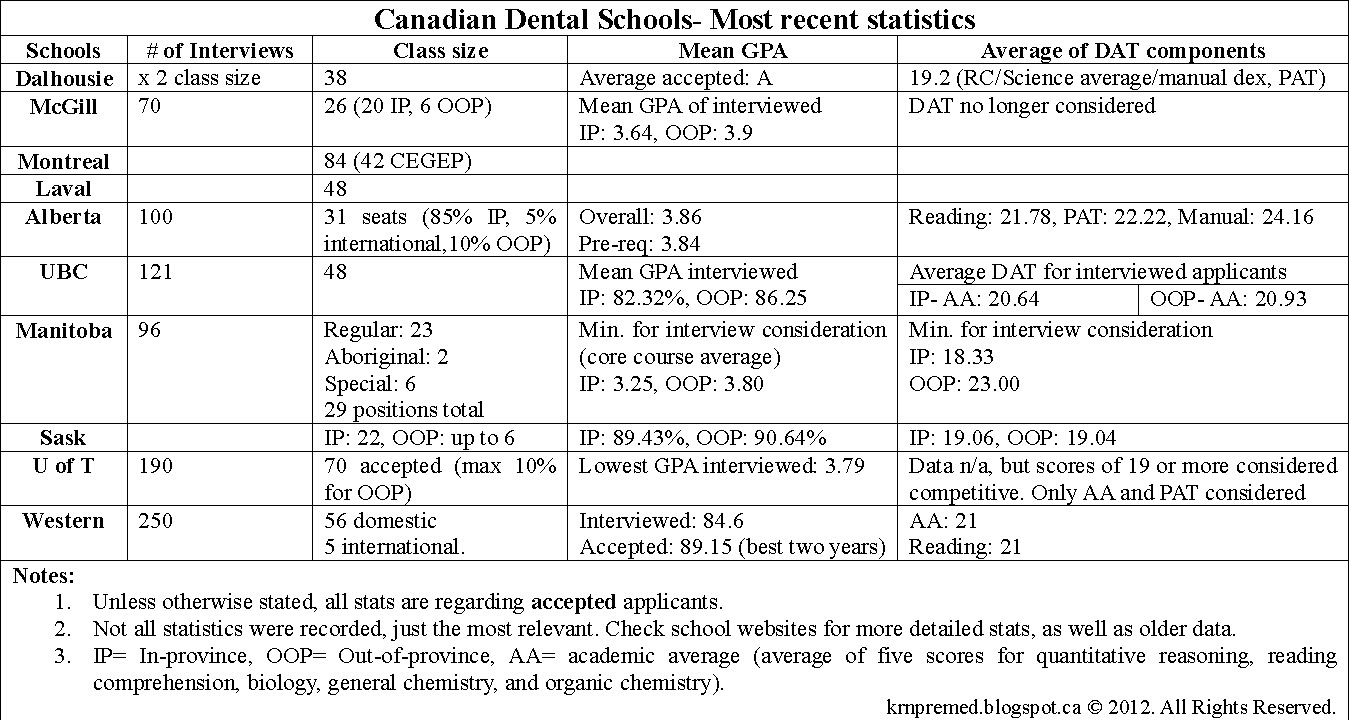
I noticed that when people start looking into fields other than medicine, some of the things that everyone is concerned about are: GPA, DAT scores, number of interviews vs seats, prerequisites, as well as extracurriculars. So I tried to compile most of them here:
Figure 1. Most recent statistics available for Canadian Dental schools admissions- click to enlarge.
Figure 2. Required courses for Canadian Dental schools- click to enlarge
Non-academic
As previously stated, dental schools tend to put much less emphasis (or almost none) on ECs- check individual school websites for further information.

Deadlines
Generally much later than med apps, often in December. Again, check websites for information.

Potential salary & Job security/market
Average income: $166,885 (2005). Similar to physicians, dentists are also decently saturated in urban areas, but still needed in less-than-urban regions. Consult the Dental Student section on Premed101 for more information.

Links to school websites


Note: All statistics used for this post were retrieved from individual school websites.

Part 2 will feature PA (Physician Assistant) programs in Canada.


Matt


Friday, June 29, 2012

Coming Soon


So it's been a while since I did anything with the blog... thought I should let people know about some awesome posts that will be coming soon-ish.

People's (Premed101's) Guide to the U of T Essay
  • Comprehensive guide based on compiled/analysed accounts of those (on Premed101)  that were successful in receiving interview invitations for U of T med. Will aim to post by August at the latest.
EDIT: U of T no longer requires the essay, starting this year I guess. They now have 4 questions, similar to the ones that McMaster had a couple of years ago.

Big List of "Back-Up" Plans for Premeds
  • An all-inclusive, easy-to-read list of alternate plans for applicants that were rejected from medical schools and considering (a) gap year(s), or another career in health care.
  • Will include factors such as minimum, average, "competitive" GPA, tests required, deadline to apply, program locations, prereqs, potential salary, job market, etc.
  • Multi-part series (~15?), including a short guide to US medical school admissions.
  • This one will take quite a while, will post intermittently throughout the year. 
Guide to Canadian med school admissions
  • An up-to-date admissions guide with recent statistics and honest advice. No BS.

...and possibly more. Probably the most useful stuff I'll ever write.

Incidentally, daily view count of this blog has almost doubled due to MCAT writers this summer (I can see google search keywords that led people to this blog)... good luck to you all. 

Matt