Showing posts with label Admissions. Show all posts

Tuesday, July 1, 2014

The Life Cycle of an "Average" Premed: a ragecomic chronicle

I've finally settled down enough to reflect on the last 4 years of applications... and thought it would be a good idea to share my application history for those of you who may be in similar positions.

As requested (many times), my year-by-year undergraduate GPA (OMSAS) :

Year 1: 3.64
Year 2: 3.75
Year 3: 3.86
Year 4: 3.86

cGPA: 3.78
wGPA (weighted for U of T): 3.88

Not the most impressive stats, as you can clearly see.

I first started applying during third year of undergrad, more for practice than expecting actual interviews given my stats at the time. I've applied every year since then, at one point applying to the US (which was a complete and utter fail- for good reason). Here's a year-to-year breakdown along with graphical illustrations of my reaction to rejections each year:

Cycle 1- 2010-2011

Applied: Queen's, Toronto, McMaster
Rejected: Queen's, Toronto, McMaster


Figure 1. Pre-intervew rejections.
Summary: Rejected pre-interview for the three schools I applied to. I was periodically checking the library computers during lab break times. My lab partner at the time didn't apply, but was accepted in our 4th year- to the same school I'll be attending, actually.

This was the year Queen's first started taking ECs into pre-interview scoring, hence the lack of an interview...

Cycle 2- 2011-2012

Applied: Queen's, Toronto, McMaster, Western, Ottawa, Manitoba, Calgary
Interview: Manitoba, Western
Rejected: Manitoba, Western

Interviews at Western & Manitoba- see How to really, really screw up important interviews: a ragecomic presentation.

Summary: As a (slightly) socially awkward & nervous interviewer, interviews did not go down well (see above link). This was during my 4th year, while I did not have any back-up plans planned. This was/is a terrible idea, I still can't stress this enough. See How I got my first research position: a ragecomic illustration for what is usually highly unlikely to happen for people without solid backup plans.

Cycle 3- 2012-2013

Applied: Queen's, Toronto, McMaster, Western, Ottawa, Manitoba, 14 US schools
Interview: McMaster (off waitlist), Western
Rejected: McMaster, Western, all US schools


Figure 2. Overly-exaggerated graphical illustration of post-rejection celebrations.
Summary: Sad times here. I prepared extensively for both interviews, practicing with friends, labmates, etc. I think the problem was (like many others) I was over-prepared, and sounded as if I was reading off a script... and consequently didn't seem like a real person. Interestingly, now that I look back- I actually thought I did well in the interview (see Interviews & raging times at the lab)... idiocy, idiocy everywhere.

To be honest, this was probably among the most (but not the most) depressing, disappointing moments in my life. Especially considering the amount of help I was given by some awesome people around me... also didn't help that I was receiving pre-interview rejections year-round (starting from September? Or something like that) from the US schools I applied to. More on that later, but mostly due to bad reference letter(s), terribly written essay & secondaries, and lack of quantifiable research during applications.

Cycle 4- 2013-2014

Applied: Queen's, Toronto, McMaster, Western, McGill
Interview: Queen's, Toronto, Western (MD/PhD)
Rejected: All MD/PhD programs, and 1 MD
Waitlist: 1 MD
Accepted: 1 MD (after initial waitlist)

Summary: This was the first year I could apply with actual research experience/accomplishments in hand, since I had only started my job around the time applications were due in the previous cycle (2012-2013). After 1-1.5 years of solid research slavery (see Enslaved by brains: a ragecomic representation), I had a reasonably decent CV for MD/PhD programs- and was lucky enough to get interviews.

The interview at the school I was accepted to was the last interview I did, whilst knowing I was rejected from all the MD/PhD programs and also highly likely rejected from the MD programs as well since the interviews occurred on the same days/weekends (and interview performance likely correlated among each other). I went into the interview saying to myself that this is the last med school interview I will ever do, and ended up as the most "real" interview I ever did- I was not nervous at all, and able to be "myself" during the entire interview. I left feeling confident, and continuously so until a week before May 13th.

--------------------------------------------------------------------------------------------

After 36 (that's a nice number) pre- and post-interview rejections, and 7 interviews over 4 application cycles, I finally have an acceptance in my hand. Even as I'm filling out paperwork, applying for my LOC, and doing all the med-like things I've always wanted to do (paperwork ftw), and as cliché as this sounds, I still can't believe I'm in. Imposter syndrome, even before starting med school...

...and I find myself wondering what I'm going to write about now in this blog of mine. Perhaps something about research? How to epic-fail at US med applications? Not really sure.

Matt

Tuesday, June 3, 2014

No longer a premed

Surprise.
It's finally official- I will no longer be a "premed". This is what happened in the last year:

Interviewed: U of T, Queen's, Western

Waitlisted: one of the above
Rejected: one of the above
Accepted: one of the above (after initial waitlist)


I will post something more coherent when I've settled down a bit.

Matt

Thursday, January 2, 2014

Big List of All Med School Interview Questions- Part 2: Multiple Mini Interview (MMI)

Figure 1. A hauntingly accurate, single-meme portrayal of the MMI.
As promised- here is the compilation of MMI interview questions... and arguably the largest collection of MMI questions in a single document.

Link: Big List of All Med School Interview Questions- Part 2: Multiple Mini Interview (MMI)

Why this collection is useful:
  1. As with the panel/traditional format, interviews can only cover so many topics of discussion and from a limited number of questions. Although this might be less applicable for the MMI, one could argue that there exist some limitations in how the questions are structured.
  2. Medical schools tend to organize their interview questions based on certain categories- although the categories here are slightly different from the panel/traditional format.
  3. The sheer number of questions & comprehensiveness of areas covered allows for a thorough understanding of the interview process, while at the same time acting as a large reservoir of practice questions for applicants.
This collection is currently organized into the following categories:
  • Section 1. Ethical decision making
    • Barely addressed in Part 1 (Panel/Traditional).
  • Section 2. Critical thinking
  • Section 3. Problem solving & conflict management
  • Section 4. Communication skills (acting)
  • Section 5. Current healthcare & societal issues
  • Section 6. Standard interview questions (redundant)
    • Small section, possibly redundant- however MMIs tend to ask different types of standard questions than the panel/traditional format.

Things to note:
  • Please note that this is only the first release, before the majority of the interviews start in Canada.
  • This is considerably less expansive than Part 1- due to many reasons:
    • A lot of material I had to withhold until further notice (many issues dealing with compromised confidentiality agreements, possible copyrights, etc).
    • I've been more swamped than ever at work.
  • Despite having said that, this compilation will get updated from time to time with the addition of more questions and such.
Release info:
Version 1.0 (January 2nd, 2014): Initial release

Acknowledgements: this collection was based on more than a dozen sources, anywhere from premed101, SDN, multiple schools' admissions websites etc.

Terms of Use:

In accessing the documents and its content ("Materials") on this site, you agree to the following terms and conditions:
  1. Permission is granted to electronically copy or print portions of the Materials for your own personal, non-commercial use. Any other use of materials on this site without our prior written consent is strictly prohibited.
  2. You must not modify paper or digital copies of the Materials you have printed off or downloaded in any way.
  3. You must not use any part of the Materials for commercial purposes.
  4. In no event, unless required by law or agreed to in writing, will "The Average Korean Premed" (krnpremed.blogspot.com) be liable to you for damages, including any general, special, incidental or consequential damages arising out of the use or inability to use the Materials.
--------------------------------------------------------------------------------------------

Please feel free to share your opinions/concerns/comments/criticism/etc.

Part 3 will be a collection of solutions/answers to some of these MMI questions (not provided by me, of course). This will take some a lot of time.

Happy New Year.

Matt

Friday, April 5, 2013

Big List of All Med School Interview Questions- Part 1: Panel/Traditional Interview

http://business-english.pl/?p=344
Hello all- here is the ultimate compilation of traditional/panel interview questions, which is arguably the largest collection of medical school interview questions in a single document.

Link: Big List of All Med School Interview Questions- Part 1: Panel/Traditional Interview

Why this collection is useful:
  1. Panel/traditional interviews can only cover so many topics of discussion and from a limited number of standard questions.
  2. Medical schools tend to organize their interview questions based on certain categories- which I've tried to emulate in this guide.
  3. The sheer number of questions & comprehensiveness of areas covered allows for a thorough understanding of the interview process, while at the same time acting as a large reservoir of practice questions for applicants.
That being said, the collection is currently organized into the following categories:
  • 1. Personal Questions
    • 1.1 Personal History
    • 1.2 Personal Details
    • 1.3 Relationships/Interactions with others
    • 1.4 Personality & Character
    • 1.5 Behavioral/Situational
    • 1.6 Personal Experiences: collaboration/teamwork/leadership
    • 1.7 Personal Experiences: character
    • 1.8 Goals & Plans
  • 2. Application Related
    • 2.1 Knowledge of Program/Specific motivations
    • 2.2 Motivation/Commitment for Medicine
  • 3. Experiences: education/medicine/healthcare
    • 3.1 Academics
    • 3.2 Healthcare, Volunteer, Extracurricular Experiences
    • 3.3 Knowledge of field/realistic view of profession
    • 3.4 Knowledge of Healthcare System/Issues (Canada)
  • 4. Ethical questions
  • 5. Other
    • 5.1 Current events/World/History
    • 5.2 Weird/out-of-the-blue/creative questions
  • 31 Questions I Wish I Had Asked: from Organization of Student Representatives Association of American Medical Colleges, January 1992
Things to note:
  • There are sometimes comments or "sample answers" at the end of questions- these are sample response and/or advice from people with more insight and knowledge than myself (successful applicants, current medical students, admission committee members).
  • Please note that this is only the first release of the guide. The questions have been through a "brief" first pass (which still took  long). There will still need to be some changes, including (but not limited to):
    • There are sometimes questions that are only relevant to US medical school applicants (this guide was originally meant to assist with both Canada and US interviews).
    • Redundancies, badly worded/bad/unnecessary questions which need to be filtered out in a more thorough review.
    • Better/more efficient categorization of questions.
  • The "Ethical questions" section is not as expansive since I will be releasing an additional collection of MMI questions which will have a large number of ethical scenarios/questions.
Release info:
Version 1.0 (April 5th, 2013): Initial release

Acknowledgements: this collection was based on more than a dozen sources, anywhere from premed101, SDN, various medical school admissions websites, etc. My goal was to at least attempt to put together a much more complete and organized collection of interview questions based on every available source.

...and just in case:


Terms of Use:

In accessing the documents and its content ("Materials") on this site, you agree to the following terms and conditions:
  1. Permission is granted to electronically copy or print portions of the Materials for your own personal, non-commercial use. Any other use of materials on this site without our prior written consent is strictly prohibited.
  2. You must not modify paper or digital copies of the Materials you have printed off or downloaded in any way.
  3. You must not use any part of the Materials for commercial purposes.
  4. In no event, unless required by law or agreed to in writing, will "The Average Korean Premed" (krnpremed.blogspot.com) be liable to you for damages, including any general, special, incidental or consequential damages arising out of the use or inability to use the Materials.
--------------------------------------------------------------------------------------------
Again, please feel free to share your opinions/concerns/comments/criticism/etc. I always welcome feedback (which I really don't get a lot of). 

Part 2 will be a collection of MMI questions, and an accompanying guide for answering interview questions (both panel and MMI)... which may take a lot longer to put together.

Matt

Friday, November 16, 2012

How to really, really screw up important interviews: a ragecomic presentation


I'm not in med school- as much as I'd like to be, I'm not. This is because I am apparently terrible at interviews (or severely lack experience with interviews, which is also the case), which led me to screw up my med school interviews in the past cycle. Here I have a graphic presentation on how to really, really screw up a med school interview. There are lessons to be learned:
Figure 1. Three awesome people I wish I would never meet again.
Figure 2. One does not simply walk into med school.
My MMI went similarly- few excellent, some good, average, and 2-3 terrible stations. Fortunately, I learned some things:
  • Prepare. Prepare early and intensely if you don't have a lot of experience with interviews, or if you're just not good with such situations (especially with MMIs).
  • Don't try to be something you're not.
    • This was my biggest mistake. Panels 6, 7 clearly show my failed attempts at trying to be someone I wasn't and the disastrous consequences that followed. You hear this advice all the time regarding interviews, but you don't actually realize it until it's too late (i.e. halfway through the interview).
  • Never get nervous.
    • Never. I was told that I lost points (during an MMI) because I seemed too nervous. I'm guessing they're not looking for people who'll grow up to be twitchy, emotionally wrecked doctors...
On the bright side, I'm really enjoying my lab work and for the first time actually glad that I got rejected (yes, seriously. Science is hard but research is awesome). Hopefully in time I'll be able to draw on some good news!

Matt

Monday, August 13, 2012

Big List of "Back-Up" Plans for Premeds- Part 2: Physician Assistant

This is Part 2 of my Big List of "Back-Up" Plans for Premeds series, intended to give a brief introduction to some alternate careers in health care that premeds might consider pursuing.

Physician Assistant Programs as well as the profession itself are very new in Canada, considering PAs were recognized by the CMA as health care professionals only in 2003.  At McMaster, the first class started in 2008 while the program was fully accredited in 2012. In Ontario, PAs are being introduced to the health care system through a 2-year demonstration and supported by the PA Employment Support Program. Considering the significance of Physician Assistants in the US (83,466 in 2010), you can expect a similar trend in Canada with the successful integration and use of PAs into the Canadian health care system.

Some important points regarding Physician Assistant Programs in Canada:
  • 2-year long, with the first year consisting of clinical sciences and second year of clinical rotations—similar to the medical school curriculum, but compressed.
  • Regarding admissions- it is hard to say what is competitive, but it has been said that GPA of 3.55 would be competitive. However, with the ever-increase in applications into health care fields (medicine, dentistry, PA, etc), competitive GPA for PA programs will definitely increase in the coming years, especially as the programs gain more public acknowledgement.
  • There are 156 programs in the US, while only 3 in Canada. Canadian PA programs are not accredited in the US, but US programs are accredited in Canada and graduates from PA programs in US can practice in Canada after writing the Canadian licensing exam.
Here is a very small chart summarizing admissions requirements for Canadian PA programs:

Figure 1. Canadian Physician Assistant Programs requirements- click to enlarge. 
As you can see, the only programs that an average applicant would be interested in are the McMaster and Manitoba programs that do not have clinical experience requirements. As such, I chose not to include any further information on the Consortium of PA education.

Statistics
For McMaster, there were ~300 applications for ~60 interviews, and 24 accepted. Other than that, there is very little data available.

Non-academic
Both Manitoba and McMaster have supplementary applications that include sections such as Employment, Volunteer/Community experiences, Awards/Distinctions/Honours, Scholarly Activities, etc. Links to supplementary applications below:

http://umanitoba.ca/faculties/medicine/media/PAEP_Suppl_App_Form_2013_INTAKE.pdf
http://bhsc.mcmaster.ca/pa/pa_application_2011.pdf

Deadlines
Similar deadlines as graduate programs: McMaster (February 1st), Manitoba (November 30th). 

Potential salary & Job security/market
As the field is still very new, there is no reliable data as of yet- however, PA income has been quoted as anywhere from 80k- 100k, sometimes higher. In the US, the mid-career median pay has been stated as $98,900. 

A publication from CMA in 2011 states "This year the University of Manitoba program graduated 13 PAs and they all had jobs within 30 days, and I know that all the McMaster graduates are employed." The same report expects that at least 3 new programs will open in the next 10 years, with the number of PAs increasing dramatically in the coming years.

Links to school websites

McMaster
Manitoba
U of T (Consortium of PA Education)

I apologize for the lack of any concrete statistics, however as previously stated there is very little data available due to the profession's recent emergence. However, it seems certain that the field shows a lot of promise as Physician Assistants could play a critical role in alleviating healthcare shortages in Canada.


Part 3 will feature Pharmacy Occupational/Physical Therapy programs in Canada.

Matt

Wednesday, July 18, 2012

Big List of "Back-Up" Plans for Premeds- Part 1: Dentistry


This is Part 1 of my Big List of "Back-Up" Plans for Premeds series, intended to give a brief introduction to some alternate careers in health care that premeds might consider pursuing.

Dentistry is not a "Back-Up" in the traditional sense, in that it's almost as difficult to get into compared to medical schools (in Canada). Instead of "Back-up", "alternate" should be more appropriate. However, it is true that there are many people that switched from medicine to dentistry for various reasons.

Some important points regarding Canadian Dental Schools:
  • Limited # of programs & very limited # of seats.
  • Required/competitive GPA is often higher than med school admissions, unless you're considered in-province in certain provinces.
  • Much more emphasis on GPA, while there is much less on DAT and extracurriculars.

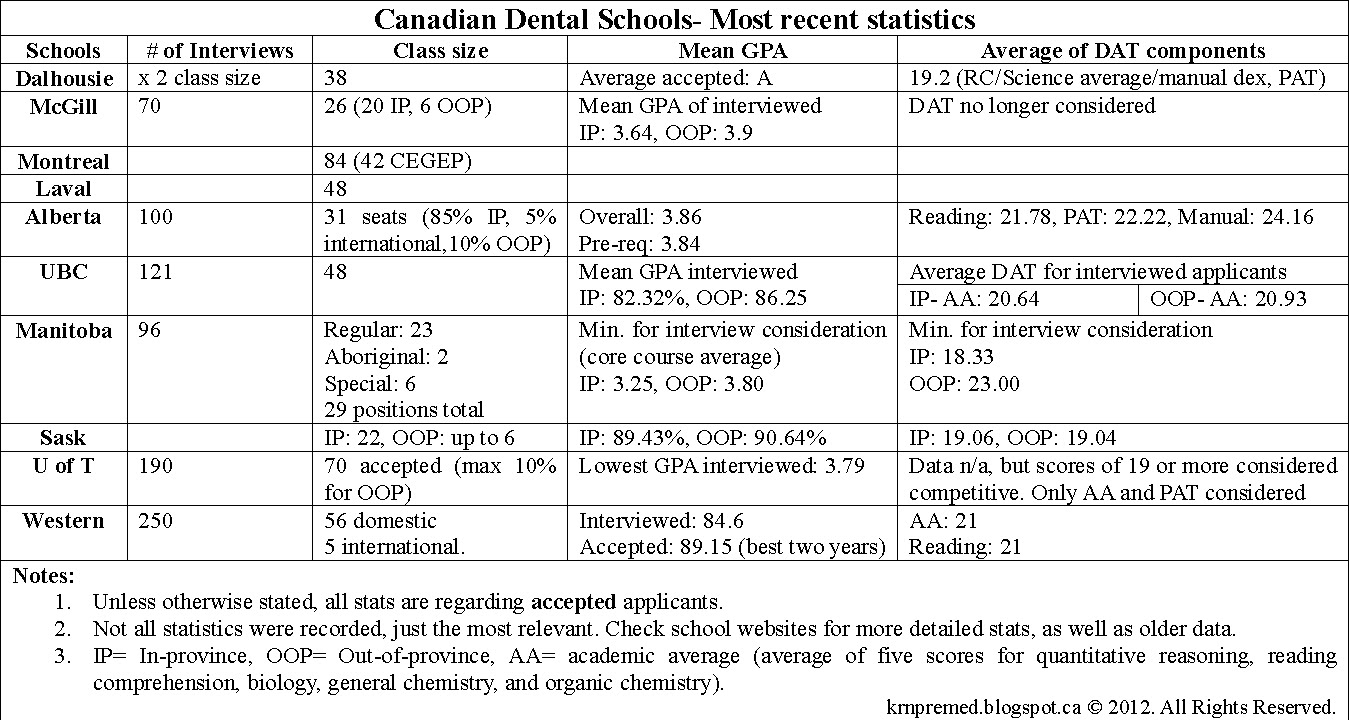
I noticed that when people start looking into fields other than medicine, some of the things that everyone is concerned about are: GPA, DAT scores, number of interviews vs seats, prerequisites, as well as extracurriculars. So I tried to compile most of them here:
Figure 1. Most recent statistics available for Canadian Dental schools admissions- click to enlarge.
Figure 2. Required courses for Canadian Dental schools- click to enlarge. 
Non-academic
As previously stated, dental schools tend to put much less emphasis (or almost none) on ECs- check individual school websites for further information.

Deadlines
Generally much later than med apps, often in December. Again, check websites for information.

Potential salary & Job security/market
Average income: $166,885 (2005). Similar to physicians, dentists are also decently saturated in urban areas, but still needed in less-than-urban regions. Consult the Dental Student section on Premed101 for more information.

Links to school websites


Note: All statistics used for this post were retrieved from individual school websites.

Part 2 will feature PA (Physician Assistant) programs in Canada.


Matt


Friday, June 29, 2012

Coming Soon


So it's been a while since I did anything with the blog... thought I should let people know about some awesome posts that will be coming soon-ish.

People's (Premed101's) Guide to the U of T Essay
  • Comprehensive guide based on compiled/analysed accounts of those (on Premed101)  that were successful in receiving interview invitations for U of T med. Will aim to post by August at the latest.
EDIT: U of T no longer requires the essay, starting this year I guess. They now have 4 questions, similar to the ones that McMaster had a couple of years ago.

Big List of "Back-Up" Plans for Premeds
  • An all-inclusive, easy-to-read list of alternate plans for applicants that were rejected from medical schools and considering (a) gap year(s), or another career in health care.
  • Will include factors such as minimum, average, "competitive" GPA, tests required, deadline to apply, program locations, prereqs, potential salary, job market, etc.
  • Multi-part series (~15?), including a short guide to US medical school admissions.
  • This one will take quite a while, will post intermittently throughout the year. 
Guide to Canadian med school admissions
  • An up-to-date admissions guide with recent statistics and honest advice. No BS.

...and possibly more. Probably the most useful stuff I'll ever write.

Incidentally, daily view count of this blog has almost doubled due to MCAT writers this summer (I can see google search keywords that led people to this blog)... good luck to you all. 

Matt

Saturday, April 7, 2012

How I destroyed the MCAT with minimal study time: a ragecomic post


After all the useful posts about "How to Destroy the MCAT with Minimal Studying", I decided to write about how I actually got through with minimal studying. In 2010, I decided to take the MCAT in May, giving myself exactly 18 days to study for the MCAT. In hindsight, it was stupid and insane- I originally planned on studying during the school year, but second year was too much so that all went to hell... but thankfully, things worked out better than I expected.

Here is a graphical + text representation of how the studying went down:


Figure 1. Started studying for the MCAT

Figure 2. Days 1-10- Reviewing general chemistry, physics, biology section, and solving problems for each section.

Figure 3. Day 11- First practice MCAT (Kaplan)- PS 7 BS 10 VR 7. Printed out dozens of practice exams for PS, and went through those for the rest of the day.

Figure 4. Day 12- Second practice MCAT (Kaplan)- PS 13 BS 9 VR 10. For the rest of the day, solved PS problems, started on VR and BS as well.

Figure 5. Day 13- Third practice MCAT (Kaplan)- epic fail, PS 8 BS 6 VR 9. For the rest of the day, solve BS problems until some sort of hemorrhage.

...and the rest:

Day 14- Practice MCAT- PS 9 BS 7 VR 9. Continue practicing BS, PS.
***Massive panic- realized I've barely practised for verbal reasoning. 
Day 15- Practice MCAT+ rest doing VR practice.
Day 16- D-4. AAMC MCAT #10, started mental prep for the actual thing.
Day 17- D-3. AAMC MCAT #8. Verbal reasoning still not good.
Day 18- D-2. Still in panic for verbal reasoning, resulting in 4 EK VR exams in a day. NOT a good idea (Refer to Part 2 of MCAT series). End of studying.

Figure 6. D-1- Dead for the entire day.

D-Day- The MCAT was a traumatic experience and my memories of it started to come back weeks later.

Figure 7. Self-portrait after writing the MCAT.
As you can see, it was a mad, frantic rush of desperation and frequent bouts of hopelessness and depression.

But by the end...
Figure 8. After receiving test scores three weeks later.
Thanks to all my previous research and the resources I got from that research, I somehow pulled it off... but this approach is too risky, and I think (and I should have as well) anyone should put aside at least 1.5 months to prepare (up to 4 depending on your major). In the end, I ended up studying ~8 hours per day, totalling ~1800 pages of work while completely fried by the end of the day, every day.

Thanks for reading, good luck!

Matt

Saturday, January 28, 2012

Coming Soon


I've always had a lot of ideas about a blog such as this, and it looks like I've been subconsciously collecting ideas for posts. In fact, some of my posts will come directly from previously written Notes on Facebook. With that said, here are some upcoming posts in the near future:


  • Why Korean-Canadian students fail in the admissions process- simple observations
    • 3 main reasons stemming from Korean social culture, ethnicity and familial background

  • General advice for Korean-Canadian students aiming for medical School
    • Why you should never NOT listen to your parents (sometimes). Seriously
    • Things to avoid

  • Comprehensive guide to Canadian med school admissions

  • Up-to-date admissions profiles for Canadian Med Schools- 캐나다 의대 집중탐구
    • Statistics, Processes, Unknown Facts
    • 1 post per medical school with the most up-to-date information and analyses

  • Queen's Life Sciences- it's not as terrible as they say

 ...and more to come. For the above listed, I already have prewritten rough drafts which may take some time to complete. Posts related to admissions, statistics, etc, will definitely take a while as I gather all my data/previously written stuff. Again, I hope to post regularly so that this blog doesn't become a pathetic waste of server space. Stay tuned.


Matt

A New Blog

Hello there,

I've decided to start a blog.

This blog will serve 3 main purposes:

1. Chronicle the struggles of an "average" "premed"* student (i.e. me) in Canada trying to get into med school. Should be funny, one hopes.
  • I'm currently in my last year of a Life Science program at a Canadian University.
  • As of now, I'm in the midst of an application cycle awaiting interview invitations. 
2. Share the very annoyingly ridiculously large amount of various information/advice/documents I've accumulated over the years regarding med admissions in Canada.
  • Premed101, has been my core source of all knowledge regarding med admissions. If you look carefully, you will find answers to all your questions in life. True story.
  • But seriously, I will be condensing the most relevant and important info (that one spent hours upon hours searching for) regarding admissions into what I hope to be semi-regular posts.
3. Serve as a reliable source (hopefully) of information for students aiming for med, especially Korean-Canadian students.
  • Over the years, I've noticed that many, many Korean students fail to succeed in admissions despite our parents continuously mauling kicking us in the process (nothing I say is literal).
  • As a result, there is a fundamental lack of support from previously succesful students for current students struggling in the process. It's appalling how some sources of information that Korean students are exposed to are so ridiculously unreliable (articles in Korean newspapers, random websites, parents etc).
  • My wish is to bridge this problem by communicating in both English and Korean, providing accurate, reliable, up-to-date info and advice geared for Korean students. Hopefully, you will find it useful.
4. Preserve my sanity.
  • I heard writing about stuff is great prophylaxis for insanity. Checking my e-mail and premed101 a thousand times a week isn't helping, either.
That's about it. I will attempt at anonymity for a while.

Matt