Showing posts with label MCAT. Show all posts

Sunday, June 2, 2013

How to destroy the MCAT with minimal study time (Part 5- Reviewing Strategies & Answers to comments)


Update (7/18/2014): Commenting has been disabled- it's been more than 4 years since I wrote the MCAT & I don't think I should continue giving out random advice & the new MCAT will render a good chunk of my MCAT-related writing obsolete. Good luck to everyone, regardless.

Hi folks,

I've been way too busy with work to answer recent comments/emails regarding the MCAT- but here are answers to some frequently asked questions:

Q: What material should I be using for BS/PS/VR/etc?

A: In my previous posts, I've cited Kaplan as the best for science sections (due to sheer difficulty) and EK for VR. However, there are alternatives that will serve just as fine- here's a list of material that you can really choose from and still do well on the MCAT:

BS, PS- Kaplan, Berkeley review, Princeton Hyperlearning (and regular Princeton), EK 1001
VR- Examkrackers (101 passages & strategy book), Princeton Hyperlearning, Berkeley review

The above are consistently cited for their effectiveness- really, any one (or multiple) should be fine. Don't be too concerned by which prep material you use- it's more about how you study & review. More on that below.

Q: Where do I get all this material?

A: I think the Kaplan practice tests I used were old, outdated ones made into pdfs... but like I said, you don't have to use Kaplan- you can use any set of practice questions and still do well.

Q: How do I improve at verbal?

A: In my opinion, no one can really tell you how to do well on verbal. There is, of course, a lot of bs flying around (especially on premed101) regarding verbal tutoring and such- but this is ridiculous, each person's critical thinking process/language capabilities/prior experiences/etc are different and what works for one person may not work for another. This is really a self-teaching process. See below for my general reviewing strategies.


Q: What was your actual schedule like?

A: I don't think knowing what my actual schedule was like would help anyone. Your schedule should depend on your own timeline (i.e. days left until MCAT), your studying habits, as well as your strengths and weaknesses. There's always a big caveat when following any advice online (yes, even on premed101)- what worked for others may not necessarily apply/work for you. In my posts, I try to emphasize specific strategies (that I and others found very helpful) that you can generalize and use them for yourself- for example, my strategy for coupling cumulative reviewing & tons of practice questions.

In any case- this is roughly how my 18 days of studying went, I have trouble remembering now:

Days 1-10: Material review (PS, BS) for 5-6 days, sectional practice questions for the rest (8-10 hours per day).
Day 11: Kaplan practice MCAT- PS 7/BS 10/VR 7. PS practice tests (~12?) for the rest of the day (10 hrs).
Day 12: Kaplan practice MCAT- PS 13/BS 9/VR 10. PS practice tests (3-4?), started on VR and BS as well (total 9-10 hours).
Day 13: Kaplan practice MCAT- PS 8/BS 6/VR 9. BS practice tests (10+ until it started to feel like bleeding in my brain) (10+ hours).
Day 14: Online (free) practice MCAT- PS 9/BS 7/VR 9. BS & PS practice tests until rest of the day.
Day 15: Practice MCAT (Kaplan full-length), VR for rest of the day.
Day 16: AAMC MCAT #10 (I completely forgot these scores- probably around PS 12/BS 13/VR 10) & 2 VR (Examkrackers) tests.
Day 17: AAMC MCAT #8 (PS 11/BS 14/VR 10) & 3 VR tests.
Day 18: 4 VR tests (not a good idea).

...and of course, I always spend a lot of time reviewing (see below). The practice tests above refer to some convoluted mix of 10 full-length tests, 8 sectional tests for BS, PS, VR (all Kaplan on paper), and 12 EK verbal tests. Practice MCATs are full-length tests that I did online- 3 Kaplan, and a couple of other random free sites I found.

The bottom line is:
  1. Lots of practice tests, as many as you can possibly handle.
  2. Thorough, continuous, cumulative review of all practice tests and the material as needed (see below).
  3. Focusing on your weaknesses one at a time and deriving realistic strategies to overcome them.

The Average Korean premed's Review strategy for the MCAT- Cumulative reviewing of concepts & practice tests

This is a strategy that I found most effective- for both science sections and improving at verbal. I always say that you can only improve by thorough practice & review, and I think this strategy is the best way to go about improving at any section. 

For Verbal- EK's strategy is almost always cited as the best strategy for verbal. However, you do need to tweak these strategies to fit your own style. I would first start off by:

1. Learn & follow EK strategy thoroughly. Don't cheat/skip steps/cut corners- every bit helps imo. The EK verbal strategy book (Verbal Reasoning and Mathematical Techniques book) has some great practice questions for learning the strategy.

2. After each practice test, review every single answer- even the ones you got right. Try to understand where you went right/wrong (you might have gotten lucky) in your reasoning by referring to the answers. This is a painful process, but crucial.

3. If you've done things right, you should be able to see where/how you can improve. Tweak the strategy/your thinking process to make it work best for you. At some point, you may need to stop changing your strategy and just stick with what you have (the best one hopefully).

4. Repeat 2-3. Space your tests apart to maximize efficiency. For example: 

Day 1: verbal practice test (strictly timed, always) & review
Day 2: review Day 1 verbal test
Day 3: another verbal practice test & review
Day 4: review Day 1, 3
Day 5: practice test & review
Day 6: review Day 1, 3, 5

You can space them apart more (depending on your schedule)- but definitely something like once every 2-4 days. I've used this sort of cumulative reviewing for the science sections as well- which really helped. For science sections, I would do something similar:

Day 1: BS + PS practice tests
Day 2: BS + PS practice tests & review Day 1
Day 3: BS + PS practice tests & review Day 1, 2
Day 4: BS + PS practice tests & review Day 1, 2, 3

...where the amount of reviewing I need to do increases every day. Similarly to verbal, I reviewed everything- even the questions I got right. 

This is, in my opinion, the best way to improve at any section- maximizing practice & retention of concepts, and effective for use with large amounts of practice tests (see How to destroy the MCAT with minimal study time (Part 4- Putting it All Together).

Matt

Wednesday, July 25, 2012

How to destroy the MCAT with minimal study time (Part 4- Putting it All Together)


Update (7/18/2014): Commenting has been disabled- it's been more than 4 years since I wrote the MCAT & I don't think I should continue giving out random advice & the new MCAT will render a good chunk of my MCAT-related writing obsolete. Good luck to everyone, regardless.

In my past posts I focused on strategies for each section of the MCAT as well as the best study materials/tactics. I noticed that a lot of Google search words that lead people to this blog are something along the line of:
  • average mcat study time, how to study for mcat in a month
  • studying for MCAT in a month
  • did well on the MCAT with minimal study
  • ...and a lot more. These are actual search words I get from Traffic Sources statistics.

So I thought I would elaborate a bit more on how to really destroy the MCAT with minimal study time (<1-2 month) based on my (and other's) experience, and why it works:
  • Acquire a very large amount of practice tests, both full-length and sectional (as in my previous posts, I prefer Kaplan for science sections due to its difficulty and EK 101 for its awesomeness).
  • As you solve through the questions, your mind begins to form a sort of database of patterns, questions & answer types/stems that's typical for each section of the MCAT.
  • There are only a finite number of types of questions and answers that can be used in an exam like the MCAT- over time, your subconscious and/or conscious mind begins to recognize similar patterns, questions/answer types and solving them becomes easier.
  • After a certain point of solving & registering a large number of said patterns & types, you begin to realize that all the other questions types will basically be derivations of previously seen patterns and types. 
  • If done over a short period of time, there is greater retention of the "data"- you remember more of the patterns and types.
  • At the end, you will be able to intuitively solve & pick out answers.

This is how I improved my score- by solving through a very large number of practice questions, I improved my "MCAT intuition".  I solved through the following:
  • 5 online full-length tests
  • 10 paper full-length tests
  • 8 sectional tests on paper for each BS, PS, VR + 12 EK 101 Verbal tests
  • ~13 topical tests for subjects I was weak on (electrochemistry, thermodynamics, etc)
  • 2 AAMC tests
  • Paper tests totalled ~1800 pages.
...in 10 days. I solved all my questions using the methods I wrote in previous posts, and always under timed conditions. For some of them I even solved 2, 3 times as I went through and reviewed wrong answers/particularly bad tests. Solving through so many questions in a short period of time really helped me see "through" the MCAT.

I always say (IRL and on premed101) that "studying" and memorizing the material helps very little for exams like the MCAT- but rather solving through as many questions as you can (or as many as you can get your hands on) is the best way to go, not just for short-term but for long-term studying as well. This holds true for undergraduate exams as well- I think most will agree that solving past exams and sample questions works best for midterms & finals in university.

A method like this may not work for everyone, but probably will for most with a good grasp of English (VR would not work out well using my method for someone who struggles with English). 

Figure 1. How I feel after answering inquiries regarding MCAT studying.
A final caveat: if you think you will be unable to commit yourself entirely, don't go for short-term studying. If you're writing after < 1 month of studying, you seriously have to go all out crazy or you'll have a bad time.


Matt

Saturday, April 7, 2012

How I destroyed the MCAT with minimal study time: a ragecomic post


After all the useful posts about "How to Destroy the MCAT with Minimal Studying", I decided to write about how I actually got through with minimal studying. In 2010, I decided to take the MCAT in May, giving myself exactly 18 days to study for the MCAT. In hindsight, it was stupid and insane- I originally planned on studying during the school year, but second year was too much so that all went to hell... but thankfully, things worked out better than I expected.

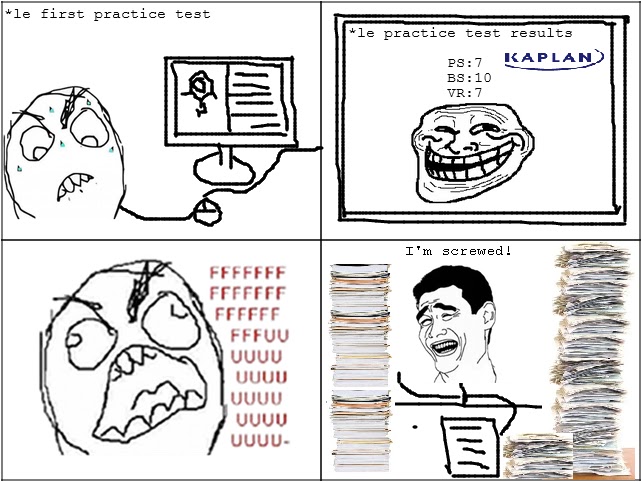
Here is a graphical + text representation of how the studying went down:


Figure 1. Started studying for the MCAT

Figure 2. Days 1-10- Reviewing general chemistry, physics, biology section, and solving problems for each section.

Figure 3. Day 11- First practice MCAT (Kaplan)- PS 7 BS 10 VR 7. Printed out dozens of practice exams for PS, and went through those for the rest of the day.

Figure 4. Day 12- Second practice MCAT (Kaplan)- PS 13 BS 9 VR 10. For the rest of the day, solved PS problems, started on VR and BS as well.

Figure 5. Day 13- Third practice MCAT (Kaplan)- epic fail, PS 8 BS 6 VR 9. For the rest of the day, solve BS problems until some sort of hemorrhage.

...and the rest:

Day 14- Practice MCAT- PS 9 BS 7 VR 9. Continue practicing BS, PS.
***Massive panic- realized I've barely practised for verbal reasoning. 
Day 15- Practice MCAT+ rest doing VR practice.
Day 16- D-4. AAMC MCAT #10, started mental prep for the actual thing.
Day 17- D-3. AAMC MCAT #8. Verbal reasoning still not good.
Day 18- D-2. Still in panic for verbal reasoning, resulting in 4 EK VR exams in a day. NOT a good idea (Refer to Part 2 of MCAT series). End of studying.

Figure 6. D-1- Dead for the entire day.

D-Day- The MCAT was a traumatic experience and my memories of it started to come back weeks later.

Figure 7. Self-portrait after writing the MCAT.
As you can see, it was a mad, frantic rush of desperation and frequent bouts of hopelessness and depression.

But by the end...
Figure 8. After receiving test scores three weeks later.
Thanks to all my previous research and the resources I got from that research, I somehow pulled it off... but this approach is too risky, and I think (and I should have as well) anyone should put aside at least 1.5 months to prepare (up to 4 depending on your major). In the end, I ended up studying ~8 hours per day, totalling ~1800 pages of work while completely fried by the end of the day, every day.

Thanks for reading, good luck!

Matt

Sunday, March 18, 2012

How to destroy the MCAT with minimal study time (Part 3- General Advice and Test Day Tips)


Update (7/18/2014): Commenting has been disabled- it's been more than 4 years since I wrote the MCAT & I don't think I should continue giving out random advice & the new MCAT will render a good chunk of my MCAT-related writing obsolete. Good luck to everyone, regardless.

Even if you've prepared well for the actual MCAT, there's still some things you need to keep in mind to ensure you can do your best on test day. I also included some general advice in studying for the MCAT. Just a reminder that all the tips/advice I give out are based on prior (copious) research, and selected for from personal experience as well.

General (Overall) Study Advice:
  • During the week(s) leading up to the MCAT, do full timed practice MCATs every day (except day before) to get you mentally prepared.
    • This is where you would use the AAMC practice MCATs. 7 and on are the most representative of the real thing (more recent).
    • If you have practised with Kaplan material (BS and PS), you will undoubtedly be able to breeze through those sections.
  • Do nothing the day before the MCAT.
    • At that point, any studying is futile and more likely to have a negative result. Take the day off to relax, sleep. 
  • Give yourself a long(er) time to study for Verbal Reasoning if you're struggling with it.
  • Although I say "minimal study time" in my titles, you should probably give yourself ample time to study (at least 1 1/2 month in my opinion). Unless you enjoy tormenting yourself and burning yourself out for the entirety of the upcoming school year.
    • I didn't do this- a decision I regretted sorely. It was miracle it all worked out- another story to come.

Test Day:
  • During the test- use every break to have a snack, a quick drink, stretch go to the bathroom.
    • Distract yourself from the previous section and start to focus on the next one while getting some nourishment (energy bars with tea work great).
  • Quick (5-10 seconds) breaks between passages- a lot of people recommend this, and has worked for me as well. Great for re-tuning your focus.
  • Don't bring any study material to the test site, because:
    • Only increases your anxiety as you would frantically go over stuff that you don't need to memorize anyways.
    • You would look like a noob. Seriously.
Figure 1. Artistic representation of people's faces when they saw the girl
with 17 sheets of study material 20 minutes before the MCAT
  • Unless you're writing next to a construction site, don't bother with headphones.
  • The obvious one- get a good night's sleep the day before.

 ...and that's the end for my useful posts on the MCAT.

Good luck.

Part 3- Done.
Matt

Saturday, February 25, 2012

How to destroy the MCAT with minimal study time (Part 2- Writing Sample)

The Writing Sample
Update (7/18/2014): Commenting has been disabled- it's been more than 4 years since I wrote the MCAT & I don't think I should continue giving out random advice & the new MCAT will render a good chunk of my MCAT-related writing obsolete. Good luck to everyone, regardless.

If you have done any prior studying for the Writing Sample, you would be familiar with the general format of the essay:

1. Thesis- explain the prompt/statement
  • Explain what the prompt is talking about, how it applies in a situation.
  • You can start the thesis in a couple of ways:
    • The statement that "prompt" is true in the sense that... (follow-up with explanation of prompt using examples) OR
    • Restate prompt in your own words, summarizing what you thought the prompt means and why (with an example).
  • I generally went with the second method, but that depends on the prompt and whether you're comfortable with rephrasing.
2. Antithesis- opposing view of the thesis.
  • Explain how the opposing view of the prompt may apply in certain situations.
3. Synthesis- resolve the conflict between opposing views.
  • Create a "rule" and explain it clearly, when the rule should apply, and when it doesn't. Basically, how to decide when to do one and when to do the other?
  • Conclusion, but not taking a side (leave it ambiguous)
That's about as short as I can describe the general format of the essays you should be writing on the MCAT.  There are a lot of online resources describing in detail on how each section should be presented, but that's really unnecessary- you know the format, you know how to think and write, it should be fine as long as you prepare properly.

Preparing for the Writing Sample

1. Before you start anything, read this PDF thoroughly:


It's surprising how so many people preparing for the MCAT don't know about this document, which basically provides a very detailed guideline to the marking scheme as well as many examples of marked essays (with detailed explanations behind the marking) with a variety of scores (1-6). Reading through the marked essays and descriptions will give you a very good idea of what is expected, and how you should be writing to get the score you want. You will even be able to mark your own essays by making comparisons to the samples in the PDF, which is obviously very useful. 

2. Always practice writing under timed conditions.

This is pretty self-explanatory- it's pointless getting good at writing the essay in an hour+, when you should be aiming to finish one essay in ~25 minutes. Practice under strict timed conditions for maximum efficiency, and you will be ready for the real thing.

3. Be self-critical: judge your own work harshly.

If you have read the PDF above, you should know where you currently stand in terms of your writing level, how prepared you are for the writing sample, etc. You may be at a 2, 3, or a 6. Don't BS yourself- if you know you need a lot of work, then do so. Continue practising with prompts from AAMC, until you are at a score range of your desire.

4. Use real-life examples to support your arguments.

This is also something a lot of people don't know about, unless they did prior research elsewhere. In using examples to support your arguments:

Real-life examples >>> Theoretical examples >>>>> No example at all

Using any real life, specific examples to support your arguments makes your essay a lot stronger. The writing sample asks you to only explain the prompt but doesn't ask for an example to support it. However, you should provide examples for both your thesis and antithesis (examples for when the statement applies and when it doesn't), preferably real-life examples. Remember that your essay is marked by a computer as well as a human marker- this is why using real life examples usually results in a better score.

Some things you should know:
  • You can twist real-life examples to fit your needs- you can write the examples with some bias so that it can support your argument better.
  • In fact, the examples I used were real-life examples about things I knew very little about, some things I heard in passing- it was almost lying, but I was able to use the little bit of information I had regarding the subjects to twist it into a good examples to support my arguments.
  • I used examples that the marker couldn't possibly know about, just in case (i.e. corporate espionage in Samsung's DRAM technology, recent actions by the president of South Korea, etc). I knew very, very little on the subject but I knew enough to vaguely cite the example and make it into good examples for my essays.
  • You can use theoretical examples ("For example, if a fireman walks into a burning building while knowing..."- possibly for a "heroism" prompt), but they are less effective than real-life examples.
  • Use any example you can think of, even those you know barely anything about- maybe something your friend mentioned the other day, a news article you skimmed through. However, make sure to word it in a way that supports your argument.
That's pretty much it- you know what you're expected to write, you should know the level of writing you should be at to get the score you want. It's just a matter of (strictly timed) practice until you can get to the level you want. Keep these in mind as you write:

  • Good transition, flow, and structure in your overall writing (look at the scored essays in the PDF, especially the ones marked 6 for an idea of what you should be aiming for)
  • Strong, clearly stated arguments- both thesis and antithesis- backed by relevant (real-life), specific examples.
  • Clear, concise writing that's easy to understand- especially your synthesis. Don't use unnecessarily long and difficult words you're not familiar with, stick to short, effective sentences.
  • Good vocabulary (wide range), grammar, spelling- remember your essay is marked by a computer as well, and minor mistakes in spelling and grammar will cost you marks.
  • Practice until you feel comfortable under timed conditions and are writing essays that are in a score range you're aiming for.
Part 2- End for now. Part 3 will discuss test day tips, as well as general advice for the MCAT.

Matt

Saturday, February 4, 2012

How to destroy the MCAT with minimal study time (Part 1- Study Material and Strategies)

Update (7/18/2014): Commenting has been disabled- it's been more than 4 years since I wrote the MCAT & I don't think I should continue giving out random advice & the new MCAT will render a good chunk of my MCAT-related writing obsolete. Good luck to everyone, regardless.

Prior to writing the MCAT after my second year (summer, 2010), I had been researching on the MCAT and its “secrets” for over a year. It was almost as if I knew I would have very little time to study for it—which was fortunate, because I really did have very little time to study due to previously unforeseen circumstances. All the prep I did prior to actual studying helped minimize the amount of time needed to do well on the MCAT, which is why I always stress the importance of research.

So it is said that if you know your enemies and know yourself, you can win a hundred battles without a single loss.

Best Study Material

Using the most effective study material is probably the most important factor in studying for the MCAT (other than actually studying). There are significant differences between major test prep companies and their materials, with some obviously being better than the others. After thorough, thorough research across premed forums (SDN, premed101), I was able to determine optimal material for each section of the MCAT as well as corresponding study strategies.

***Important to note: You will not succeed on the MCAT by memorizing all the facts, formulas, minute detail in prep books. Understanding the concepts outlined and correctly applying them on the test material is the only approach you should be taking—to do that well, you need ample practice with the best material.

But wait, why should you listen to me?
Good point. Short answer is- I studied for exactly 18 days before my MCAT. My scores were in the top ~2% percentile. I will elaborate on my story in a later post- it is a thrilling tale; I wish to do it justice.

Learning the Material

This really depends on your background—if you have an extensive background in the sciences, use Kaplan to review concepts you’ve learnt before as the Kaplan prep books are not overtly detailed and provide a good general overview of the concepts. If your background is not in sciences, I would recommend Princeton Review (Or even Berkeley Review, but those are hard to come by) for their detailed outline of the material. As long as you understand the concepts, you should be fine.


Practice for Physical Sciences (PS), Biological Sciences (BS)

For the two science sections, Kaplan practice tests are the way to go. In terms of difficulty (on average):

Kaplan PS, BS > Actual MCAT >>> AAMC practice tests

Other test prep companies fall somewhere below the actual MCAT. Kaplan is consistently cited as having the most difficult practice tests—by the time you get to write the actual beast, the PS and BS sections will seem so much easier because you’ve spent all your time tackling passages and questions that were significantly harder.

Study Strategy
  • Work through as many practice test as you possibly can.
    • After a few practice tests, you should do all your practice under strict timed conditions.
  • For every question you answer incorrectly, read the solutions manual and completely understand the concept behind the question before doing any more practice.
In my case, I worked my way through about 10 practice tests each for PS and BS. On the actual MCAT, I had a decent run through PS, breezed through BS. After endless hours of ripping through countless practice tests, I found that I understood the concepts much more clearly and could easily see through the passages and questions to find the answer.


Verbal Reasoning (VR)

Practice. Only practice, and learning from your mistakes & adjusting your strategy accordingly will help you here. However, the gold standard for VR practice is the Examkrackers 101 Passages, as well as their VR strategies book (Verbal Reasoning and Mathematical Techniques). Every other test prep companies fall way below EK with regards to difficulty, accurate representation of the actual MCAT and quality practice questions.

Strategy

This is the EK strategy for approaching VR:

(adapted from premed101)

1. Read the passage critically (attack it like you are a professor reading a student's work)
2. Take a 5 second break before each passage, including the first one. This helps you to maintain focus on the passage.
3. Read every word.
4. Try not to go back to the passage so much (they recommend doing a few passage questions without reading the passage at all, to show that you can gain a lot of info from the question stems and answers themselves)
5. Do the passages from start to finish. You have to read every single passage and attempt to answer them.
6. Don't get caught up on the hard questions - if you aren't finishing on time, then you have to learn to give up and move on.

The above strategies are excellent (and has worked very well for many people), but eventually you will find your own personalized method of tackling VR passages. In terms of studying:
  • Do not use more than one practice test in a day—there are only ~14 (golden) EK practice tests available, you want to maximize their use by spreading them out.
  • After each practice test, look to see what questions you answered incorrectly, assess what you’re doing wrong and make adjustments to your strategy to improve. Continue making adjustments until you’re scoring at a consistent range (10-11).
  • Learn to have the framework of the entire passage in your head before answering the questions.
Part 1- End. My score breakdown: 12/11/14/R (PS/VR/BS/WS)

Part 2 will discuss the Writing Sample (WS) as well as general advice.


Matt

Saturday, January 28, 2012

Coming Soon


I've always had a lot of ideas about a blog such as this, and it looks like I've been subconsciously collecting ideas for posts. In fact, some of my posts will come directly from previously written Notes on Facebook. With that said, here are some upcoming posts in the near future:


  • Why Korean-Canadian students fail in the admissions process- simple observations
    • 3 main reasons stemming from Korean social culture, ethnicity and familial background

  • General advice for Korean-Canadian students aiming for medical School
    • Why you should never NOT listen to your parents (sometimes). Seriously
    • Things to avoid

  • Comprehensive guide to Canadian med school admissions

  • Up-to-date admissions profiles for Canadian Med Schools- 캐나다 의대 집중탐구
    • Statistics, Processes, Unknown Facts
    • 1 post per medical school with the most up-to-date information and analyses

  • Queen's Life Sciences- it's not as terrible as they say

 ...and more to come. For the above listed, I already have prewritten rough drafts which may take some time to complete. Posts related to admissions, statistics, etc, will definitely take a while as I gather all my data/previously written stuff. Again, I hope to post regularly so that this blog doesn't become a pathetic waste of server space. Stay tuned.


Matt