Showing posts with label Canadian. Show all posts

Friday, April 5, 2013

Big List of All Med School Interview Questions- Part 1: Panel/Traditional Interview

http://business-english.pl/?p=344
Hello all- here is the ultimate compilation of traditional/panel interview questions, which is arguably the largest collection of medical school interview questions in a single document.

Link: Big List of All Med School Interview Questions- Part 1: Panel/Traditional Interview

Why this collection is useful:
  1. Panel/traditional interviews can only cover so many topics of discussion and from a limited number of standard questions.
  2. Medical schools tend to organize their interview questions based on certain categories- which I've tried to emulate in this guide.
  3. The sheer number of questions & comprehensiveness of areas covered allows for a thorough understanding of the interview process, while at the same time acting as a large reservoir of practice questions for applicants.
That being said, the collection is currently organized into the following categories:
  • 1. Personal Questions
    • 1.1 Personal History
    • 1.2 Personal Details
    • 1.3 Relationships/Interactions with others
    • 1.4 Personality & Character
    • 1.5 Behavioral/Situational
    • 1.6 Personal Experiences: collaboration/teamwork/leadership
    • 1.7 Personal Experiences: character
    • 1.8 Goals & Plans
  • 2. Application Related
    • 2.1 Knowledge of Program/Specific motivations
    • 2.2 Motivation/Commitment for Medicine
  • 3. Experiences: education/medicine/healthcare
    • 3.1 Academics
    • 3.2 Healthcare, Volunteer, Extracurricular Experiences
    • 3.3 Knowledge of field/realistic view of profession
    • 3.4 Knowledge of Healthcare System/Issues (Canada)
  • 4. Ethical questions
  • 5. Other
    • 5.1 Current events/World/History
    • 5.2 Weird/out-of-the-blue/creative questions
  • 31 Questions I Wish I Had Asked: from Organization of Student Representatives Association of American Medical Colleges, January 1992
Things to note:
  • There are sometimes comments or "sample answers" at the end of questions- these are sample response and/or advice from people with more insight and knowledge than myself (successful applicants, current medical students, admission committee members).
  • Please note that this is only the first release of the guide. The questions have been through a "brief" first pass (which still took  long). There will still need to be some changes, including (but not limited to):
    • There are sometimes questions that are only relevant to US medical school applicants (this guide was originally meant to assist with both Canada and US interviews).
    • Redundancies, badly worded/bad/unnecessary questions which need to be filtered out in a more thorough review.
    • Better/more efficient categorization of questions.
  • The "Ethical questions" section is not as expansive since I will be releasing an additional collection of MMI questions which will have a large number of ethical scenarios/questions.
Release info:
Version 1.0 (April 5th, 2013): Initial release

Acknowledgements: this collection was based on more than a dozen sources, anywhere from premed101, SDN, various medical school admissions websites, etc. My goal was to at least attempt to put together a much more complete and organized collection of interview questions based on every available source.

...and just in case:


Terms of Use:

In accessing the documents and its content ("Materials") on this site, you agree to the following terms and conditions:
  1. Permission is granted to electronically copy or print portions of the Materials for your own personal, non-commercial use. Any other use of materials on this site without our prior written consent is strictly prohibited.
  2. You must not modify paper or digital copies of the Materials you have printed off or downloaded in any way.
  3. You must not use any part of the Materials for commercial purposes.
  4. In no event, unless required by law or agreed to in writing, will "The Average Korean Premed" (krnpremed.blogspot.com) be liable to you for damages, including any general, special, incidental or consequential damages arising out of the use or inability to use the Materials.
--------------------------------------------------------------------------------------------
Again, please feel free to share your opinions/concerns/comments/criticism/etc. I always welcome feedback (which I really don't get a lot of). 

Part 2 will be a collection of MMI questions, and an accompanying guide for answering interview questions (both panel and MMI)... which may take a lot longer to put together.

Matt

Sunday, December 30, 2012

Big List of "Back-Up" Plans for Premeds- Part 4: Nursing

This is Part 4 of my Big List of "Back-Up" Plans for Premeds series, intended to give a brief introduction to some alternate careers in health care that premeds might consider pursuing.

I would like to introduce nursing as a career, and accelerated nursing programs that you can enter after having completed some university work. 

What does a nurse actually do?
  • Nurses perform a wide range of duties, from:
    • Technical- i.e. monitoring the patient's vital signs, I.V.s & medical devices, collecting samples.
    • Administrative/Educative- maintaining records, triage, educating public & families.
    • Clinical- assess the patient, evaluate care diagnostic testing, dispensing medication, small procedures.
    • Counseling support for patients and families as well as personal hygiene.
    • ...and many more. There are thousands of things that nurses do and I can't compress that into a neat list.
  • Nurses work in a variety of settings- direct care, research, education, public health, etc. Find out more at the Canadian Nurses Association.
I think one of the greatest benefits for nursing is that there are a lot of things you can do with a nursing degree after graduation- there are a lot of choices that you can take advantage of. Furthermore, the role and scope of nursing is always expanding in Canada.

Possibility of further training
  • With further training, nurses are able to extend the scope of their practice. There are advanced training opportunities available for Registered Nurses, such as:
    • Anesthesia assistant, advanced life support (cardiac, pediatric, etc) certificates
    • Procedure-based training such as ultrasound, sonography
    • Research training- clinical research associate
    • Clinical nurse specialist
    • Administration
  • Nurse practitioner- NPs act as primary health care providers, functioning autonomously at a similar level of scope and authority as family physicians/physician assistants/etc. You can become an NP by going through advanced programs (usually Master of Nursing, Nurse Practitioner programs) after becoming a RN.

With that said, since this is a "Back-Up" series I will only write regarding Accelerated Nursing programs which have shorter time frames (~2 years) than regular nursing programs (~4 years).

Important points regarding Accelerated Nursing Programs in Canada:
  • Generally 2-year long programs entering at Level III (third year) of regular nursing programs, includes both theory and clinical components.
  • Often require X number of university credits (usually 10 full course credits= 2 full years), and ~B averages (~75%, 3.0).
  • Prerequisite courses generally include physiology, anatomy, psychology, statistics. Check school websites for details.
  • There are plenty of accelerated nursing programs, ranging from 1.8 to 3.5 years in length.
Potential salary & Job security/market

As you may already know, nurses usually have no problem finding a job. In 2010, 93.4% of RNs were employed in nursing, 1.8% outside of nursing, while only 2.7% were unemployed. For Nurse Practitioners, 97.3% were employed in nursing, 0.6% outside of nursing, and only 0.9% unemployed. Considering there were 287,344 RNs and 2554 NPs in 2010, I would say the job security for nurses look great.

Salaries are based on:
  • Seniority/experience
    • For example, hospital nurses in Ontario are paid according to a "grid" where salary increases with each year of experience for RNs.
    • Starting salary is $30.17/hr ($58,831.50 annual), while after 5 years it's $36.12/hr ($70,434.00).
  • Amount of additional training
    • RNs with advanced training are paid slightly more, along with increased flexibility and scope of their practice in terms of locations, hours, etc. For example, salary for NPs range from $80,000 to +$100,000, which is significantly higher than average RN salaries.
  • Location
    • Similar to other healthcare professions, pay differs from province to province.
Nurses have a huge variety of options in employment and practice along with great job security- which makes nursing all the more attractive as an alternative profession in healthcare. Consider nursing before thinking about leaving Canada for international medical schools that are associated with increasing restrictions & difficulties (along with a huge price tag) of coming back to Canada.

Matt

Monday, October 29, 2012

Big List of "Back-Up" Plans for Premeds- Part 3: PT/OT


This is Part 3 of my Big List of "Back-Up" Plans for Premeds series, intended to give a brief introduction to some alternate careers in health care that premeds might consider pursuing.

I would like to introduce physiotherapists (PT) and occupational therapists (OT)- both professions play critical roles in healthcare, helping patients improve in ways different from medicine. They work in a variety of healthcare settings- hospitals, private practice, home care, industry, government.

PTs are responsible for "evaluating, restoring and/or enhancing physical function and independence" through their "knowledge of the muscles, tendons, ligaments and bones of your body along with a thorough understanding of how they all work together." (Manitoba Physiotherapy Association)
OTs  "provide the skills for the job of living and solves the problems that interfere with peoples ability to do the activities or occupations that are important to them." (CAOT)

PTs and OTs perform a wide range of services for patients to improve their quality of life- you can find out more from Canadian Physiotherapy Association and Canadian Association of Occupational Therapists.

Important points regarding PT/OT Programs in Canada:
  • Generally 2-year long course-based Masters programs with integrated clinical education.
  • GPA is most important factor in admissions (sometimes the only factor in admissions), with some schools placing emphasis on extracurriculars and interviews.
Here are some large charts summarizing general information and prereqs regarding PT/OT programs in Canada- information regarding francophone schools (Laval, Montreal,  Ottawa) has not been included because all information is in French only:

Figure 1. Canadian Physiotherapy Programs-click to enlarge
Figure 2. Canadian Physiotherapy Programs prereqs- click to enlarge.
Figure 3. Canadian Occupational Therapy Programs- click to enlarge
Figure 4. Canadian Occupational Therapy Programs prereqs- click to enlarge
Statistics
Regarding Ontario OT/PT programs, there are ~600-1300 applications for ~60-80 seats per school- see stats at ORPAS. For other programs, competition seems fairly lax- anywhere from 100-700 applications for a decent number of seats.

Non-academic
Most schools require you to submit CVs, personal statements/letter of intent detailing your personal aspirations and extracurricular activities. Check school websites for more details.

Potential salary & Job security/market

In both professions, salaries can vary greatly depending on your experience, scope and location of practice (hospital or private, Ontario or Alberta, for example).

In 2010, PTs' hourly wages ranged from $26.55 to $41.52. In Alberta, pay scale can range from $32.00 to $48.00. According to CAOT, new OTs earn from $40,000 to $45,000- hourly wages for OTs ranged from $29.32 to as high as $42.50 in Toronto (2010). 

Links to school websites

Dalhousie University: PT OT
McGill University
Queen's University
McMaster University
University of Toronto: PT OT
Western University: PT OT
University of Manitoba: PT OT
University of Saskatchewan (PT only)
University of Alberta
UBC: PT OT


You wouldn't believe how long it took me to make those charts... definitely longer than what was needed. I think I will stop with overly-detailed charts from now on. Part 4 will feature Nursing, Accelerated/Compressed Nursing programs in Canada.

Matt

Monday, August 13, 2012

Big List of "Back-Up" Plans for Premeds- Part 2: Physician Assistant

This is Part 2 of my Big List of "Back-Up" Plans for Premeds series, intended to give a brief introduction to some alternate careers in health care that premeds might consider pursuing.

Physician Assistant Programs as well as the profession itself are very new in Canada, considering PAs were recognized by the CMA as health care professionals only in 2003.  At McMaster, the first class started in 2008 while the program was fully accredited in 2012. In Ontario, PAs are being introduced to the health care system through a 2-year demonstration and supported by the PA Employment Support Program. Considering the significance of Physician Assistants in the US (83,466 in 2010), you can expect a similar trend in Canada with the successful integration and use of PAs into the Canadian health care system.

Some important points regarding Physician Assistant Programs in Canada:
  • 2-year long, with the first year consisting of clinical sciences and second year of clinical rotations—similar to the medical school curriculum, but compressed.
  • Regarding admissions- it is hard to say what is competitive, but it has been said that GPA of 3.55 would be competitive. However, with the ever-increase in applications into health care fields (medicine, dentistry, PA, etc), competitive GPA for PA programs will definitely increase in the coming years, especially as the programs gain more public acknowledgement.
  • There are 156 programs in the US, while only 3 in Canada. Canadian PA programs are not accredited in the US, but US programs are accredited in Canada and graduates from PA programs in US can practice in Canada after writing the Canadian licensing exam.
Here is a very small chart summarizing admissions requirements for Canadian PA programs:

Figure 1. Canadian Physician Assistant Programs requirements- click to enlarge. 
As you can see, the only programs that an average applicant would be interested in are the McMaster and Manitoba programs that do not have clinical experience requirements. As such, I chose not to include any further information on the Consortium of PA education.

Statistics
For McMaster, there were ~300 applications for ~60 interviews, and 24 accepted. Other than that, there is very little data available.

Non-academic
Both Manitoba and McMaster have supplementary applications that include sections such as Employment, Volunteer/Community experiences, Awards/Distinctions/Honours, Scholarly Activities, etc. Links to supplementary applications below:

http://umanitoba.ca/faculties/medicine/media/PAEP_Suppl_App_Form_2013_INTAKE.pdf
http://bhsc.mcmaster.ca/pa/pa_application_2011.pdf

Deadlines
Similar deadlines as graduate programs: McMaster (February 1st), Manitoba (November 30th). 

Potential salary & Job security/market
As the field is still very new, there is no reliable data as of yet- however, PA income has been quoted as anywhere from 80k- 100k, sometimes higher. In the US, the mid-career median pay has been stated as $98,900. 

A publication from CMA in 2011 states "This year the University of Manitoba program graduated 13 PAs and they all had jobs within 30 days, and I know that all the McMaster graduates are employed." The same report expects that at least 3 new programs will open in the next 10 years, with the number of PAs increasing dramatically in the coming years.

Links to school websites

McMaster
Manitoba
U of T (Consortium of PA Education)

I apologize for the lack of any concrete statistics, however as previously stated there is very little data available due to the profession's recent emergence. However, it seems certain that the field shows a lot of promise as Physician Assistants could play a critical role in alleviating healthcare shortages in Canada.


Part 3 will feature Pharmacy Occupational/Physical Therapy programs in Canada.

Matt

Wednesday, July 18, 2012

Big List of "Back-Up" Plans for Premeds- Part 1: Dentistry


This is Part 1 of my Big List of "Back-Up" Plans for Premeds series, intended to give a brief introduction to some alternate careers in health care that premeds might consider pursuing.

Dentistry is not a "Back-Up" in the traditional sense, in that it's almost as difficult to get into compared to medical schools (in Canada). Instead of "Back-up", "alternate" should be more appropriate. However, it is true that there are many people that switched from medicine to dentistry for various reasons.

Some important points regarding Canadian Dental Schools:
  • Limited # of programs & very limited # of seats.
  • Required/competitive GPA is often higher than med school admissions, unless you're considered in-province in certain provinces.
  • Much more emphasis on GPA, while there is much less on DAT and extracurriculars.

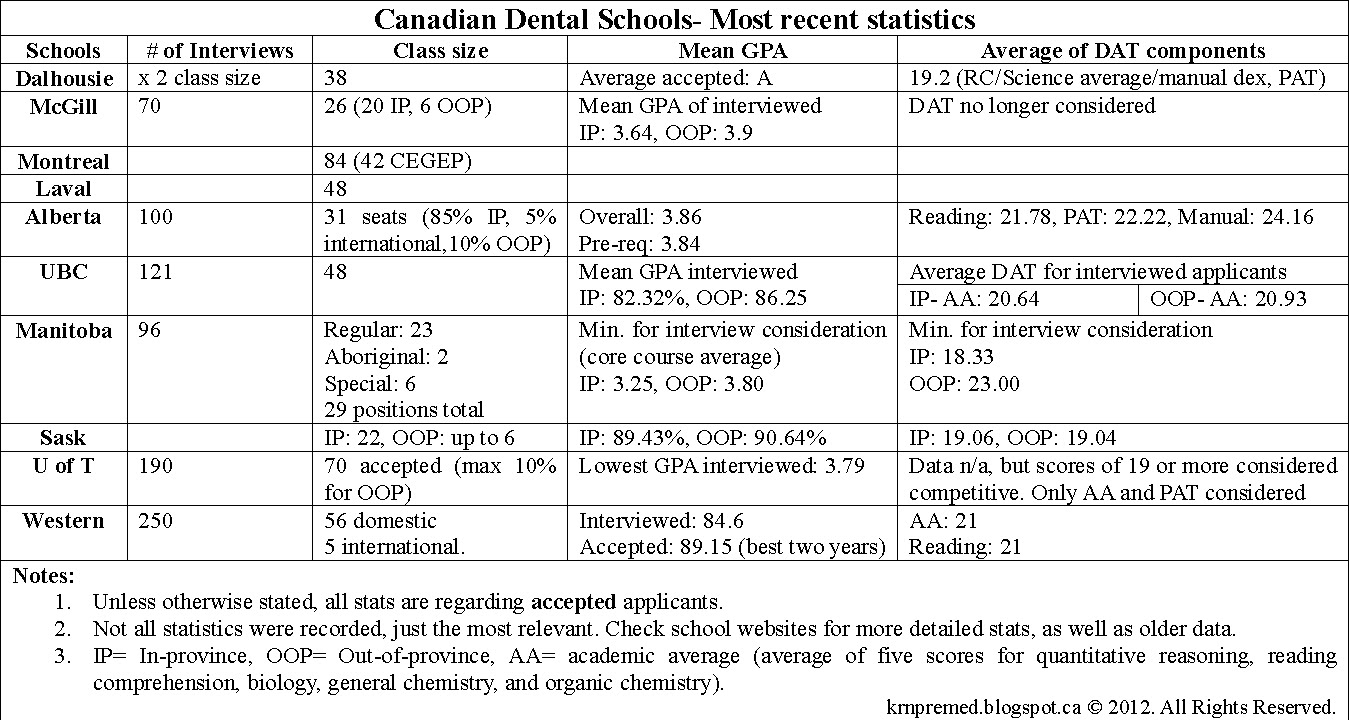
I noticed that when people start looking into fields other than medicine, some of the things that everyone is concerned about are: GPA, DAT scores, number of interviews vs seats, prerequisites, as well as extracurriculars. So I tried to compile most of them here:
Figure 1. Most recent statistics available for Canadian Dental schools admissions- click to enlarge.
Figure 2. Required courses for Canadian Dental schools- click to enlarge. 
Non-academic
As previously stated, dental schools tend to put much less emphasis (or almost none) on ECs- check individual school websites for further information.

Deadlines
Generally much later than med apps, often in December. Again, check websites for information.

Potential salary & Job security/market
Average income: $166,885 (2005). Similar to physicians, dentists are also decently saturated in urban areas, but still needed in less-than-urban regions. Consult the Dental Student section on Premed101 for more information.

Links to school websites


Note: All statistics used for this post were retrieved from individual school websites.

Part 2 will feature PA (Physician Assistant) programs in Canada.


Matt


Saturday, January 28, 2012

Coming Soon


I've always had a lot of ideas about a blog such as this, and it looks like I've been subconsciously collecting ideas for posts. In fact, some of my posts will come directly from previously written Notes on Facebook. With that said, here are some upcoming posts in the near future:


  • Why Korean-Canadian students fail in the admissions process- simple observations
    • 3 main reasons stemming from Korean social culture, ethnicity and familial background

  • General advice for Korean-Canadian students aiming for medical School
    • Why you should never NOT listen to your parents (sometimes). Seriously
    • Things to avoid

  • Comprehensive guide to Canadian med school admissions

  • Up-to-date admissions profiles for Canadian Med Schools- 캐나다 의대 집중탐구
    • Statistics, Processes, Unknown Facts
    • 1 post per medical school with the most up-to-date information and analyses

  • Queen's Life Sciences- it's not as terrible as they say

 ...and more to come. For the above listed, I already have prewritten rough drafts which may take some time to complete. Posts related to admissions, statistics, etc, will definitely take a while as I gather all my data/previously written stuff. Again, I hope to post regularly so that this blog doesn't become a pathetic waste of server space. Stay tuned.


Matt

A New Blog

Hello there,

I've decided to start a blog.

This blog will serve 3 main purposes:

1. Chronicle the struggles of an "average" "premed"* student (i.e. me) in Canada trying to get into med school. Should be funny, one hopes.
  • I'm currently in my last year of a Life Science program at a Canadian University.
  • As of now, I'm in the midst of an application cycle awaiting interview invitations. 
2. Share the very annoyingly ridiculously large amount of various information/advice/documents I've accumulated over the years regarding med admissions in Canada.
  • Premed101, has been my core source of all knowledge regarding med admissions. If you look carefully, you will find answers to all your questions in life. True story.
  • But seriously, I will be condensing the most relevant and important info (that one spent hours upon hours searching for) regarding admissions into what I hope to be semi-regular posts.
3. Serve as a reliable source (hopefully) of information for students aiming for med, especially Korean-Canadian students.
  • Over the years, I've noticed that many, many Korean students fail to succeed in admissions despite our parents continuously mauling kicking us in the process (nothing I say is literal).
  • As a result, there is a fundamental lack of support from previously succesful students for current students struggling in the process. It's appalling how some sources of information that Korean students are exposed to are so ridiculously unreliable (articles in Korean newspapers, random websites, parents etc).
  • My wish is to bridge this problem by communicating in both English and Korean, providing accurate, reliable, up-to-date info and advice geared for Korean students. Hopefully, you will find it useful.
4. Preserve my sanity.
  • I heard writing about stuff is great prophylaxis for insanity. Checking my e-mail and premed101 a thousand times a week isn't helping, either.
That's about it. I will attempt at anonymity for a while.

Matt